On Meeting Users Where They Are.
When "just migrate bro" isn't as compelling as you hope.

This post just represents some thinking I'm doing ahead of the the FediForum Un-Workshop next week about Growing the Open Social Web. I'm not sure if any of these ideas are going to be fully coherent. And if they're coherent I'm not sure if they're gonna be especially compelling. And some of it is duplicative of my earlier position post submitted to the workshop, but this is an intent to explore the same ideas in more detail.
But I wanted to start to get my thoughts at least lightly organized so I'm ready to discuss them next week.
I've been chattering to my friends, family, and co-workers about the open social web for about a decade now. I joined the Fediverse in 2017 and then the Atmosphere in 2024. And I find that a lot of the really cool things that I'm excited to talk about are not compelling to people (hmm actually that happens in a lot of areas, maybe that's actually more of a me problem haha). Or, they may be compelling in theory, but they don't readily manifest themselves as tangible benefits that incentivize people to migrate away from closed platforms onto the open social web.
Lots of people don't care about "owning" their shitposts
For example, "you can own your own data," isn't an especially compelling pitch to people who just sorta scroll their feed, dropping likes here and there, maybe a funny comment. Those people are likely to wonder, "what data?" or "why would I care about owning that?" More complete portability in the fediverse, and better backup and migration tooling in the atmosphere are important pursuits and make these promises more tangible, but it doesn't necessarily make it more compelling.
The big promise that sounds like a slam dunk - in my experience - really isn't: "Migrations between services are a snap." Take your follows - and even followers - with you and nobody necessarily even needs to know that you moved. Great, right?
Look, people by and large are exhausted with social media. We talk a lot in these spaces about the toxicity of mainstream social media. We talk about the coercion of these platforms, dark design patterns and opaque algorithms maximizing addiction and unhealthy usage and engagement.
No matter what friendly name we use to dress up our networks, these are the feelings people associate with social media. I find even appeals to nostalgia seem to lead only to the hopeless conclusion that "those days are gone," not that those days are still right now but it's being hidden from you.
You're already asking them to think about changing what may be deeply ingrained (and potentially unhealthy) habits and even to think about uprooting some of their current relationships (parasocial or otherwise). And now when you say "and if Bluesky or your instance admin ever turns evil..." you're asking them to think about the next migration already. You might think it sounds reassuring to say "and you'll never have to worry about this again," but most people don't have enough context to be able to visualize that. Even if they trust you enough to take your word for it intellectually, they are still going to feel that dread deep within them of "what you do you mean next time, why should I even bother then?"
People in this position are not going to be amenable to suggestions for migration or replacement of platforms. Especially not for microblogging or short-form video platforms that their logical brain might say they don't really care about, but their emotional brain has a very strong attachment to.
What if instead we could come to them? What if we could embrace the strengths of the open social web to bring real tangible value to people without asking them to entirely uproot themselves? In fact, what if we could do it in ways that don't even really read as "social media" and side-step that whole emotional attachment part of the conversation?
But we are embracing our strengths!
Yeah, kinda. Developers, designers, and millions of users have been out there every day for - well, longer than the decade I've been aware of it - defining specifications, implementing foundational capabilities, and building real, functional decentralized networks of interoperable systems. And that is something to be celebrated.
But we shouldn't expect people to find value in the same things we do. People who already have X don't need Bluesky. People who already have Instagram don't need Pixelfed. People who already have Twitch don't need Streamplace. We might love all of this, but we really can't expect other people to be motivated by the same things as us and often people simply aren't motivated by "it does most of the same stuff but maybe a little differently."
We should think about what new experiences we can only build on the open social web that can provide immediate tangible value to people.
There are two general strengths I think we can lean into here: open data access and interoperability between systems. These are two more strengths that - as mentioned above - we can't really expect people to care about intrinsically, but they are strengths we can use to build unique experiences that provide real value to users. In some cases, it can even allow us to offer this value without asking them to make any scary or tedious migrations.
Meeting users where they are?
Yeah, so this is a thing I've been thinking about a lot recently. And I don't have a lot of answers to this, but I do have some examples that I find tickle my brain in very interesting ways.
As a community, we talk fairly frequently about "Embrace, Extend, Extinguish." I probably don't need to define or describe it (feel free to click through to the wikipedia page if you need that). So I've been wondering recently what the inverse of that is. How can we use open protocols to extract open value from closed platforms, liberating users and their data in the process - all without them having to reorganize their lives until or unless they are ready?
I'm not clever enough to even attempt to coin a term here, but I'm sure there's plenty of prior art to be found in the history and types of interoperability.
But here's something I've been thinking through:
My wife runs a small business. When we first started dating, she was selling on Etsy. Etsy - as well as other marketplace platforms - offer increased discoverability for businesses. People find you through a global search, algorithmic recommendations, sponsored listings, etc. And in return for that, they essentially own your relationships with your customers and can use platform coercion to influence how you run your business.
How often do you put things on sale, how quickly do you ship items, when do you offer free shipping, how likely are you to offer refunds to unhappy customers? All of these things do (or at least may threaten to) impact your rankings in the global search. If you decide not to play the game, you're paying Etsy margins and listing fees but not getting the full benefit of the platform.
Eventually, my wife decided to move to her own website, hosted by Squarespace. While she of course technically had control of her shop policies on Etsy, now she actually has control over them. However, she loses the benefit of discoverability offered by a well-known global marketplace. Years later she's still working on SEO strategies and figuring out how to drive more traffic to her site.
Indeed, sellers leaving the platform cannot take their customers or those relationships with them directly - they are very explicitly Etsy's users. But even further, Etsy's policies discourage sellers from directing users off-site for transactions. There seems to be a bit of disagreement on sellers forums about how strict this policy is, but there is an Off-Platform Transactions policy that states, "taking communications and transactions off-platform is not allowed" which raises serious doubt that one could add "find me on my new website" to their shop info.
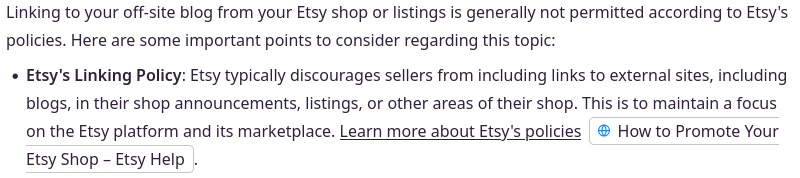
Etsy's (incredibly unhelpful) seller community AI assistant takes it one step further, suggesting, "Etsy typically discourages sellers from including links to external site...in their shop announcement, listing, and other areas...to maintain a focus on the Etsy platform and its marketplace." (the chatbot offers the typical "accuracy not guaranteed" disclaimer).
What the hell am I talking about here and what does this have to do with social media?
Well, are you seeing any parallels here with certain popular microblogging platforms?
To extend the parallels, the common response from the open social web community might be "well we have to build our own artisan marketplace platform and get people to migrate over! We could call it ShopSky, or FediMarket, or or Motsy! I'll go buy the domain now."
And maybe that's a great idea! But let's look at incentives and our proposed value to our prospective users here. They're feeling exploited by a marketplace platform but possibly scared of making a migration and losing what benefits they are still afforded by the platform. Asking them to move to a new (but decentralized!) platform puts a tremendous amount of work and risk onto them for no immediate or obvious benefit.
What if instead we could meet them where they are and provide them a low-risk way to branch out while simultaneously starting to grant them ownership over their own data and their own customer relationships, further reducing the effects of platform lock-in and coercion?
Warning: I'm about to get super hand-wavy here. And I haven't reviewed terms of service for most of these platforms.
Etsy has an API. Squarespace has an API. Shopify has an API. Probably other ecommerce and marketplace platforms have APIs.
What if we built a global search and discovery tool that worked with those platforms? Sellers could sign up and integrate their stores. This integration can sync their shop information, inventory, updates, etc with a PDS. This can enable a global marketplace-of-marketplaces, providing buyers with global search and discovery tools eventually landing them on whatever platform the seller is currently selling on to complete the transaction, saving us having to build "the hard stuff."
In some ways, yes, we're simply feeding value back into closed platforms. In other ways, though, we're beginning the process of liberation. Sellers begin building discovery paths for their buyers that don't care where their shop lives and start taking control of their own data. This reduces the risk associated with making migrations in the future, but doesn't pressure them to do it Right Now™️.
And once we're done leveraging the interoperability offered by these closed platforms, we can get into the additional sorts of interoperability available to us once the data has been liberated. Sellers can bring in their microblog posts to their profile. Shop reviews can be sourced from backlinks. Sellers can start tracking craft fairs or pop-up events on smokesignal. Artists can embed livestreams of them creating their work via streamplace.
All of this value can be delivered in an additive and incremental manner, with low risk to the seller, and crucially without having to use scary words like "migration." If it doesn't work out? Disconnect the integration and you don't have to worry about it anymore. If it does work out? Maybe down the line you feel more free to move to a different ecommerce platform for transactions but everything else can just stay in place.
So what am I trying to say here?
Ultimately what I'm trying to get at is: most of the people intrinsically motivated by the benefits of the open social web are already here.
Building one-to-one open and ethical alternatives to closed platforms has been and continues to be important work, but we should also be thinking about:
- what we can build using the strengths of the open social web that closed alternatives cannot
- how we can deliver real value to users where they are right now without needing to do scary or risky things like completely moving their social presence
These are tricky things to consider, but innovation and collaboration are a non-technical strength of open communities.
The thought of "extending" closed platforms to extract value and liberate users and their data is really interesting to me and something I'm going to be noodling over for a while.
Lemme know if you have any thoughts. In the meantime I'm going to be trying to cut this down to lightning talk length or ideally shorter. But at least I've got a starting point now.
![A poorly-drawn cartoon computer with a happy face on the monitor stands next to text: "Don't say tariffs [x4]...oops"](/content/images/size/w600/2025/04/dontsaytariffs.png)